
Last Updated:
October 3, 2026
Once a lawn gets large enough, mowing it with a walk-behind mower can become a time-consuming chore. That is where riding equipment comes in. Ride-on mowers and zero-turn mowers both let you cover more ground while seated, but they are designed with different priorities in mind.
Traditional ride-on mowers are built around familiar steering and straightforward operation, while zero-turn mowers focus heavily on speed, maneuverability, and efficient turns. Understanding those differences can make it easier to see which type of equipment fits a particular property for proper lawn mowing.

A traditional ride-on mower places the operator behind the engine with a steering wheel controlling the front wheels. The mower moves much like a small vehicle, making the controls relatively familiar for anyone who has driven a car or lawn tractor.
These machines are well suited to properties with broad, open areas where the mower can make longer passes without constantly navigating around obstacles. Depending on the model, a ride-on mower can also handle attachments and other lawn-care tasks beyond basic mowing.
Ride-on mowers can be a practical choice for homeowners who want the comfort of seated mowing without the more specialized controls of a zero-turn machine. They are particularly useful for:
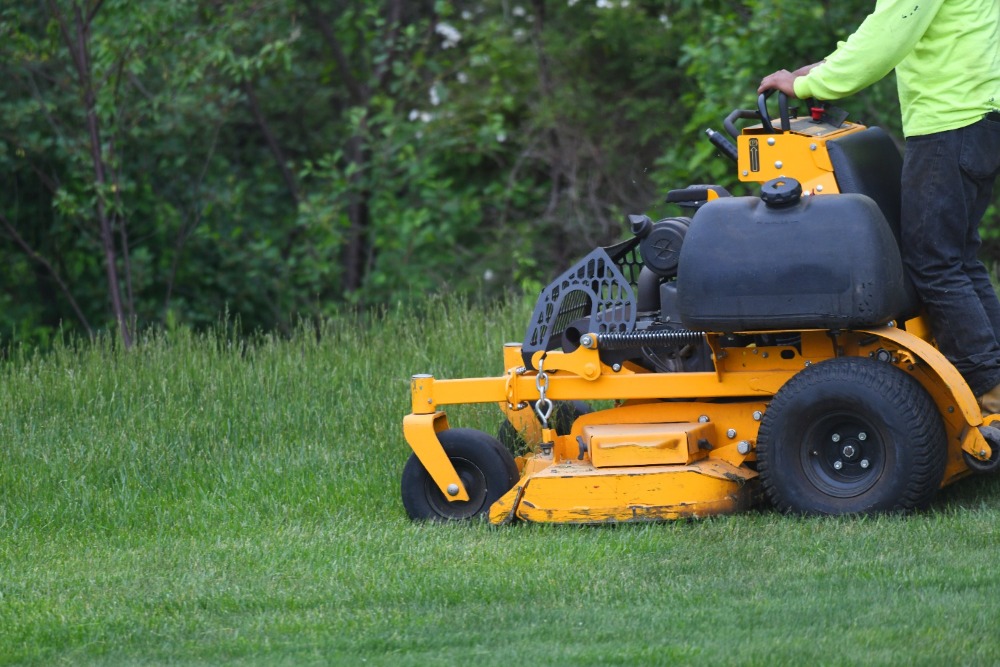
Zero-turn mowers take a different approach to steering. Instead of a conventional steering wheel, they typically use two control levers that independently regulate the mower's drive wheels.
This allows the machine to make extremely tight turns. A zero-turn mower can rotate around its rear wheels and change direction without making a wide looping turn. That difference becomes especially noticeable when mowing around trees, planting beds, fences, buildings, and other landscape features.
The biggest advantage of a zero-turn mower is not simply that it drives quickly. Its real benefit comes from how efficiently it moves through a property.
A mower that can turn tightly spends less time repositioning between mowing passes. Instead of making a large turn at the end of each row, the operator can pivot and head directly into the next section. Zero-turn mowers are especially useful for:
The two mower types can both handle substantial lawns, but their designs create noticeable differences during operation. The differences become more apparent as lawn size increases or the landscape becomes more complicated.
Ride-on mowers tend to emphasize familiarity, versatility, and ease of operation. Their steering-wheel design makes them approachable for homeowners who are accustomed to conventional lawn tractors.
Zero-turn mowers place greater emphasis on maneuverability and productivity. Their dual-lever controls take some practice, but they allow much tighter turns and more precise movement around obstacles.
There is no single mower design that works equally well on every lawn. The property's size, layout, terrain, number of obstacles, and mowing frequency all matter.
A traditional ride-on mower may be suitable for a relatively open residential property where straightforward operation is a priority. A zero-turn mower may make more sense for a large or detailed landscape where frequent turns and repositioning would otherwise slow the job down. When selecting equipment, consider:
Professional mowing crews have to consider productivity on every property they service. When several lawns need to be maintained during the same workday, equipment that can cover large areas efficiently becomes especially valuable.
Zero-turn mowers are commonly used for this type of work because they combine wide cutting decks with precise maneuverability. A crew can cover open sections quickly while navigating around many of the features found throughout a landscaped property.
That does not make traditional ride-on mowers obsolete. Their straightforward controls and versatility can still make them useful for certain properties and mowing situations.
Q: Is a zero-turn mower faster than a traditional ride-on mower?
A: Zero-turn mowers are generally designed for higher mowing speeds and more efficient turning. Their productivity advantage can be especially noticeable on larger properties.
Q: Are ride-on mowers easier to operate?
A: Many people find traditional ride-on mowers easier to learn because they use a steering wheel and controls that resemble those found in other vehicles.
Q: What makes a zero-turn mower turn differently?
A: Zero-turn mowers typically use two independent drive levers. The operator can control each side separately, allowing the mower to make very tight turns and pivot within a small area.
Q: Are zero-turn mowers good for large lawns?
A: Yes. Their combination of wide cutting decks, maneuverability, and speed makes them well suited to many large properties.
Q: Can a ride-on mower handle a large property?
A: Yes. Traditional ride-on mowers can efficiently maintain large lawns, particularly when the property has broad, open areas and relatively few obstacles.
Q: Do zero-turn mowers take longer to learn?
A: They can. The dual-lever steering system operates differently from the steering wheel found on a traditional ride-on mower, so new operators may need some practice before using the controls comfortably.

